 ByAdmin
The Underground Revolution Mushrooms usually make headlines for the wrong reasons. Poisonings, toxic species, that sort of thing. But Kumar Biswajit Debnath, a researcher at the University of Technology Sydney, wants us to look past the mushroom itself and focus on what’s really interesting: the stuff underneath.After diving into what’s happening in this space, I’m convinced we’re watching something transformative unfold.
The thing most people don’t realise is that the mushroom you see is just the fruit. The actual organism is this incredible white thread network called mycelium, spreading through soil and wood like nature’s own internet. These threads, called hyphae, are tubular structures that intertwine to form a lightweight, lattice-resembling foam.
According to Debnath’s work, this underground web might actually help us tackle some pretty massive climate and waste problems. Think about it. Mycelium is literally everywhere, including forests, compost piles, and dead wood under your feet. It’s nature’s recycler, breaking down organic matter and turning waste into nutrients. A single network can stretch for miles. We just never see it doing its thing
The Underground Revolution
Debnath and researchers like him are using mycelium as a kind of living construction material. The fungi naturally bind to whatever htthey’re eating (sawdust, straw, agricultural waste) and basically glue it all together as they grow.
This is exactly what Ecovative, the company that pioneered mass mycelium farming, discovered back in the day. Founders Eben Bayer and Gavin McIntyre mixed mycelium with agricultural waste like corn stover or hemp, put it in a mold, and let nature do its thing. In just four days, you’ve got a rigid structure. Grow it for two more days and it gets coated with a soft, velvety layer. Heat it to stop the growth, and boom, you’ve got a building material that required no machinery, no plastics, barely any energy.
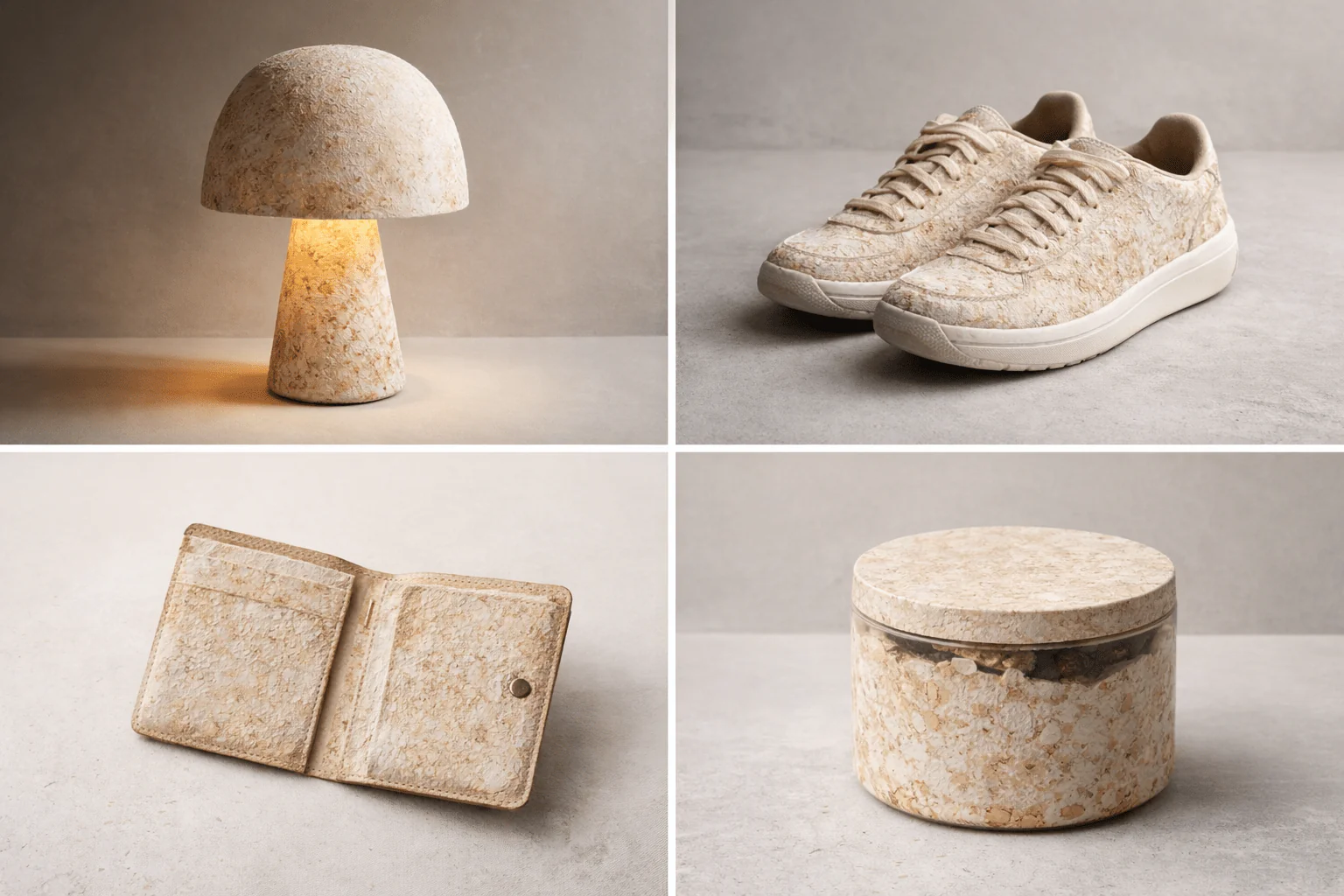
Debnath has some pretty cool examples from his own work. Like composite panels made with Australian Reishi fungi and local waste like sugar mill bagasse, golf course mulch, and hemp. The applications are diverse – packaging alternatives to polystyrene, synthetic insulation replacements, acoustic panels, even leather-like materials.
The scale of what’s possible is kind of mind-blowing. In a recent video, science educator Matt Ferrell (from Undecided with Matt Ferrell) visited Ecovative’s indoor farm where they’re growing what they call “AirMycelium”. These are pure mycelium sheets harvested from oyster mushrooms. On just one acre of land, they produce three million square feet of material each year. That’s nearly 700,000 square metres per hectare.

And it’s not just experimental anymore. In 2025, a 316-unit affordable housing complex called The Phoenix is opening in West Oakland, California, with exterior cladding made from mycelium panels. These are 36-foot-long prefabricated panels grown from Ecovative’s mycelium-and-hemp blend, then encased in a fiber-reinforced-polymer shell. They’ll serve as thermal insulation, cutting energy costs while being naturally fire-resistant and carbon negative.
But wait, it gets weirder. That same mycelium can be compressed and embossed to create leather that luxury brands like Hermès are using in handbags. Or sliced thick, brined, and fried to make bacon that’s apparently on shelves in over 1,400 stores. Ferrell tried it and said it passed the sizzle test. MyBacon is now the fastest-growing plant-based meat in the northeast US.