 ByAdmin
Alice in Wonderland Trippy You’ve probably seen it happen. Someone describes a movie poster, a bedroom tapestry, a music video, or a strange dream sequence as “very Alice in Wonderland.” They usually don’t mean Victorian children’s literature. They mean warped scale, talking objects, impossible logic, a rabbit hole into a reality that feels playful and unsettling at the same time.That’s why Alice in Wonderland trippy has become such a durable phrase. It names a whole mood. You can use it for surreal art, psychedelic visuals, immersive theater, neon decor, stop-motion films, or even that feeling of losing the normal rules of time and proportion.What makes this especially interesting is that the phrase joins together two different histories. One starts in the nineteenth century with literary nonsense. The other arrives much later, when popular culture began reading Wonderland through a psychedelic lens. Put those together, and you get one of the most recognizable surreal aesthetics in modern culture
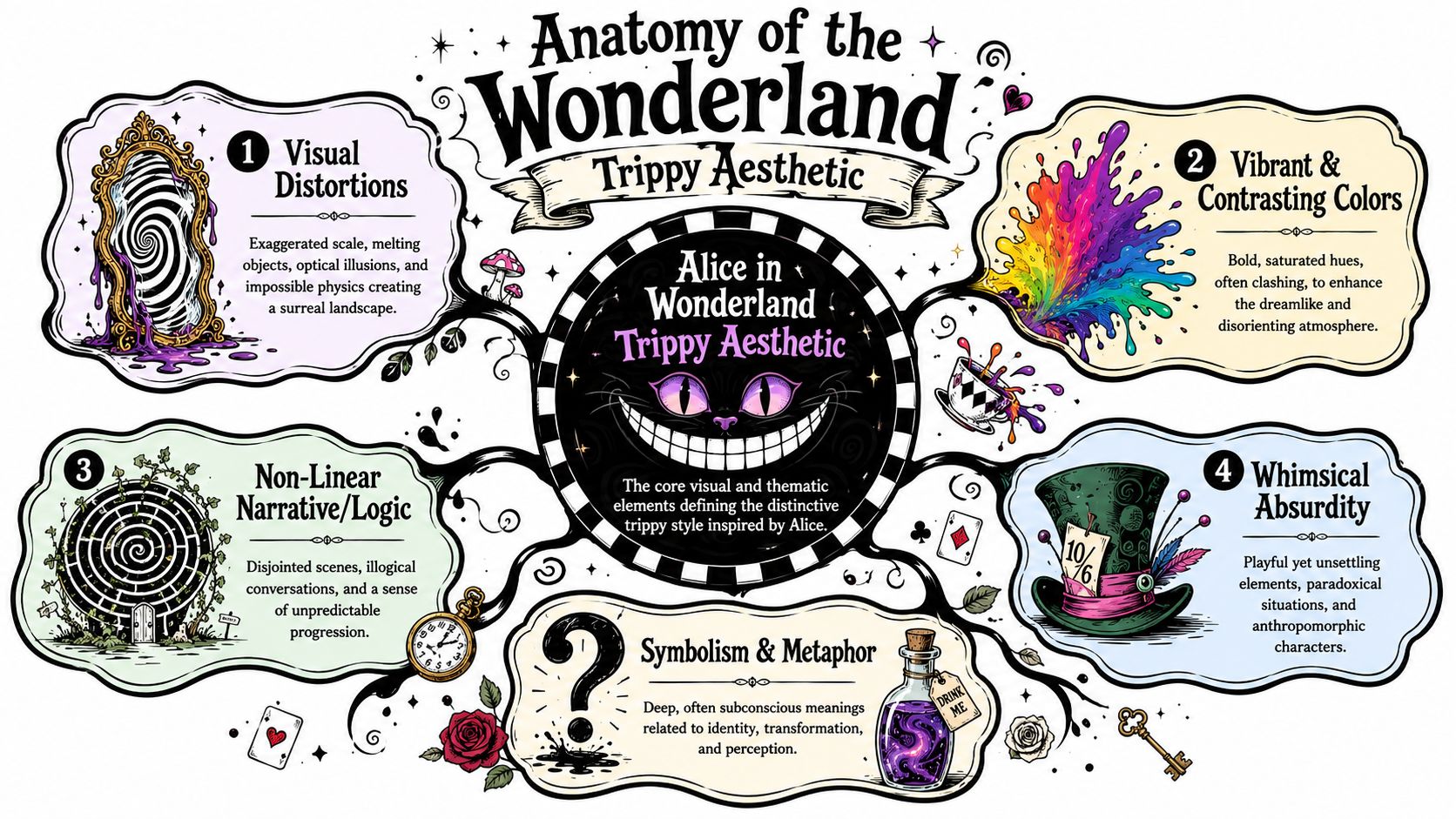
You don’t have to know the book well to recognize the feeling. Alice gets smaller, then larger. Animals talk like people. A grin floats without a cat. A tea party follows its own broken rules. Doors, bottles, cards, mushrooms, and mirrors stop behaving like ordinary objects and start acting like symbols.
That’s the core of why people call it trippy. Wonderland keeps removing the stable reference points that help us feel oriented. Size changes. Language slips. Identity becomes uncertain. Time feels unreliable. The world stays vivid, but it no longer stays consistent.
For many readers and viewers, that resemblance to altered perception is immediate. If you want a broader sense of why surreal experiences get described in those terms, this overview of whelps explain the language people often borrow when they talk about distortion, intensity, and unusual thought patterns.
Wonderland feels “trippy” because it makes normal reality negotiable. Nothing fully breaks, but nothing stays fixed either.
A quick example makes this clearer. If a fantasy story gives you dragons, you still know the rules of that world. In Wonderland, the rules keep changing while you watch. Alice isn’t just visiting a magical place. She’s moving through a place where logic itself keeps shape-shifting.
That’s why the story became shorthand for surreal experience. It captures confusion without losing charm. It offers nonsense, but carefully designed nonsense. And it gives that nonsense memorable images people keep recycling in art, music, fashion, and visual culture.

People often misunderstand this particular aspect. They assume the “trippy” label was built into the book from the start. It wasn’t. Carroll wrote for Victorian readers, and the story belongs to the tradition of literary nonsense, not drug allegory.
That distinction matters. The original power of Alice comes from verbal play, paradox, reversals, and dream logic. The Caterpillar asks destabilizing questions. The Queen turns emotion into law. The tea party treats conversation like a machine that has come loose from its gears.
Tenniel’s drawings reinforced that effect. They didn’t just decorate the text. They gave form to its absurdity. A child falling into impossible space, creatures with human posture, and cards becoming authority figures all helped lock Wonderland into the visual imagination.
The psychedelic reading came much later. A major shift happened in the 1970s, when Alice became strongly associated with drug-culture imagery and psychedelic aesthetics rather than being understood mainly as Victorian nonsens
That later adoption makes sense for a simple reason. Wonderland already had the right ingredients. It was full of unstable scale, odd transformations, strange conversations, and a protagonist trying to make sense of a world that refused to stay orderly. Popular culture didn’t have to invent those elements. It reinterpreted them.