 ByAdmin
Where to Get Shrooms You’ve probably seen the shift happen in real time. A friend mentions mushroom gummies. A podcast guest talks about psilocybin services. A search for where to get shrooms turns up everything from spores to chocolates to city-specific advice, and most of it feels either too vague or too slick to trust.That confusion makes sense. The mushroom market now includes research programs, local policy carve-outs, online shops, and wellness products that may or may not be psychoactive. If you’re trying to make an informed decision, the hard part isn’t finding options. It’s figuring out which options are real, which are relevant to where you live, and which ones give you enough information to judge quality and safety for yourself.
A lot of adults are in this exact spot. They’re curious, they want clear information, and they don’t want to sort through rumor, hype, or half-explained policy terms.
That interest isn’t fringe. Those numbers help explain why so many people are now looking for practical guidance instead of abstract debate.
What usually trips people up is that “where to get shrooms” can mean very different things. One person is asking about a structured program with screening and support. Another is trying to understand what local decriminalization changes. Someone else is comparing online retailers and wants to know how to separate a transparent seller from a risky one.
Clear sourcing advice starts with one question: what kind of access are you actually looking for?
If you need a policy baseline before you compare options, this overview of phelps frame the situation without drowning you in legal jargon.
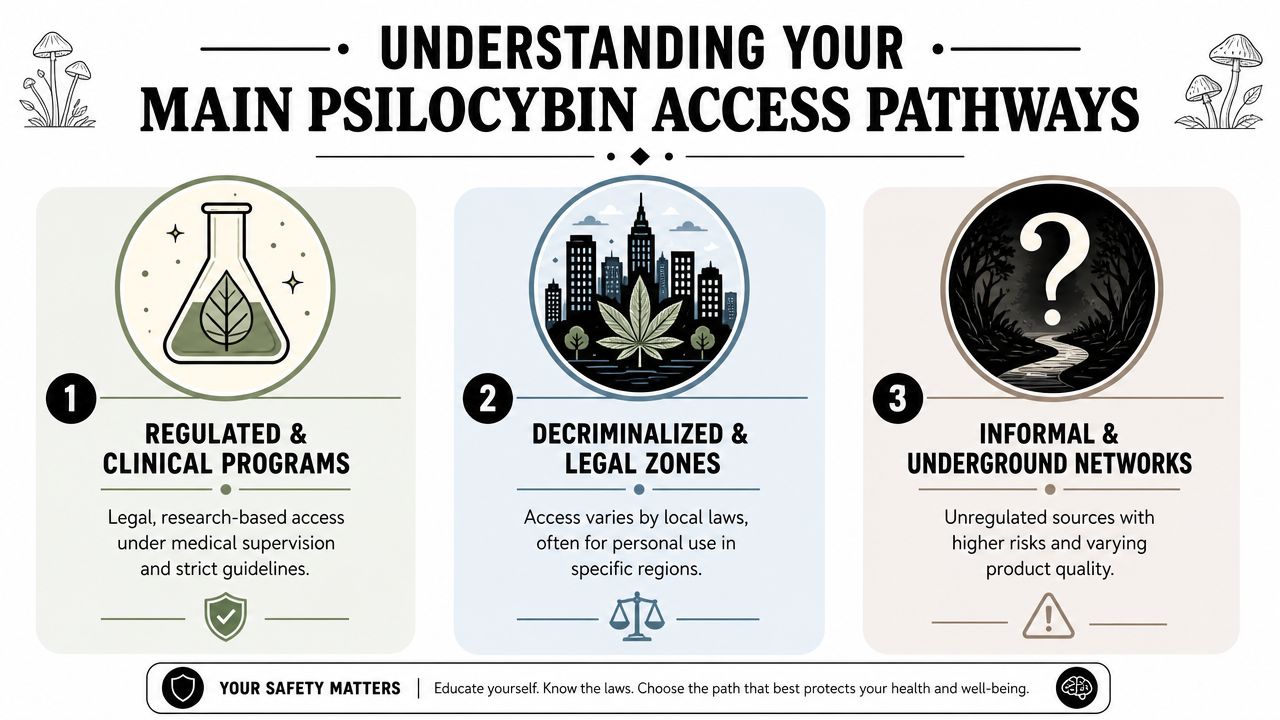
The useful way to approach this topic is to stop thinking in terms of one answer and start thinking in terms of pathways. Each pathway comes with different expectations around availability, product format, screening, privacy, and verification. Once you know which path you’re evaluating, the decision gets much simpler.
People often lump every source into one bucket. That’s where mistakes start. A better comparison is travel: one route looks like a scheduled program with fixed steps, one depends on the local terrain, and one works more like direct ordering where vetting the provider matters most.

Regulated programs are the most structured route. Access is tied to formal systems such as research participation or state-run service models. People don’t usually “shop” this route the way they shop online. They apply, qualify, schedule, and follow program rules.
Decriminalized environments are easier to misunderstand. These are places where local policy may reduce enforcement priority around personal use, but that doesn’t automatically create storefront access, broad product menus, or standardized consumer protections.
Online retailers are the most familiar format for modern buyers because the experience resembles e-commerce. You browse formats like dried mushrooms, capsules, gummies, chocolates, or mushroom coffee, compare listings, and evaluate the seller’s transparency, age checks, shipping practices, and lab information.
| Pathway | Typical Access Method | Product Formats | Best For |
|---|---|---|---|
| Regulated programs | Application, screening, scheduled participation | Program-defined formats | Adults who want structured support |
| Decriminalized environments | Local networks, personal cultivation context, community referrals | Varies widely | People focused on local policy realities |
| Online retailers | Website ordering and delivery | Raw mushrooms, gummies, chocolates, capsules, coffee | Adults who want convenience and product comparison |